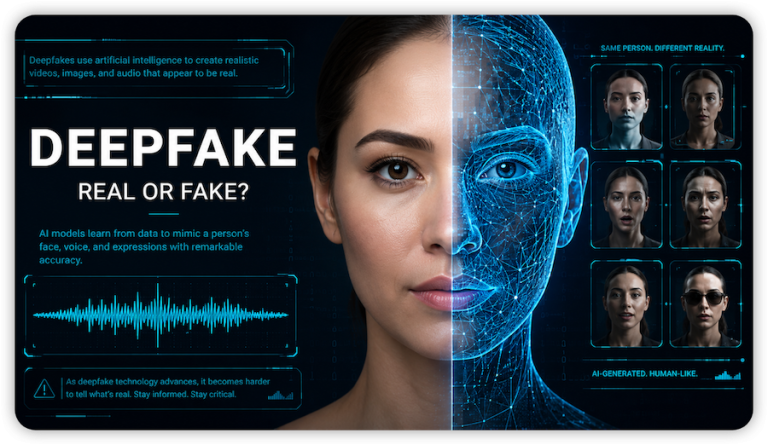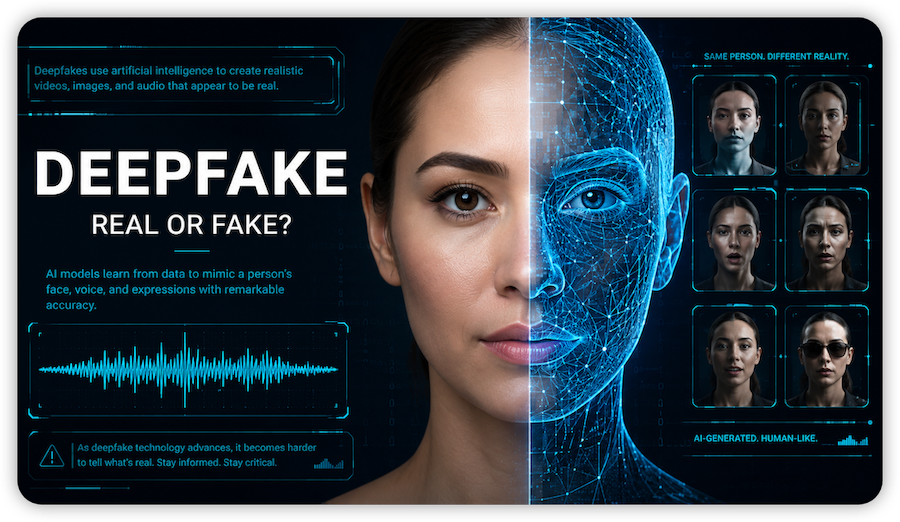
In January 2024, a finance employee at the engineering firm Arup joined what looked like a routine video call with the company’s CFO and several colleagues. Over that call he authorised fifteen separate wire transfers worth about $25.6 million. No system was breached. No password was stolen. Every other person on the call was a deepfake.
What made it work was not the technology. It was an assumption. A familiar face and a familiar voice were treated as sufficient proof of identity, and that assumption still sits underneath most payment approvals, access resets and hiring decisions in business today.
The threat model most tools were built for
Security spending has been organised for years around the idea of a breach. Something gets compromised: a system, a credential, a network. Detection tools look for the technical signature of that compromise, and most of them are good at it.
A call like the Arup one produces no such signature. Nothing is broken into. The attacker asks an authorised employee to do something that employee is authorised to do, and the employee does it. No firewall sees anything. No endpoint agent fires. The entire attack lives inside a conversation, and it succeeds because the target follows normal procedure in response to what looks like a normal request.
This is a genuinely awkward category. It is not a technology failure, so technology controls miss it. It is not carelessness either, which is why awareness training has had limited effect. The employee at Arup was not being reckless. He was doing his job, with what appeared to be his CFO on screen telling him to.
Why deepfake detection alone does not close the gap
The obvious response is to detect the synthetic media, and a growing number of tools now do. They have two limitations worth understanding before anyone treats them as a fix.
The first is timing. Most detection was built to analyse recorded content, a video file or an audio clip, after someone thinks to check it. That is useful for verifying a recording. It does very little for a live call, where the fraud starts and finishes inside a few minutes. By the time an analysis comes back, the transfer has cleared.
The second is coverage. A substantial share of the calls that cost companies money involve no synthetic media at all. They are a real person, working from a script, applying pressure. A detector pointed at that call correctly reports that nothing is fake, and the money still leaves.
The sequence is the signal
What these attacks have in common is not the technology. It is a shape.
The attacker establishes a believable role first: a cloned executive, a title agent, a vendor the company has worked with for years. Time pressure follows, compressing whatever verification would normally happen. The deal closes today. Payroll runs within the hour. The channel narrows, often shifting to a private call or direct message where there are no witnesses. Stakes escalate, frequently wrapped in secrecy. Only at the end does the actual ask land: approve this transfer, reset this MFA, change these wire instructions, extend this offer.
Any single step looks ordinary. Plenty of legitimate calls are urgent, and plenty are private. What distinguishes a fraudulent call is the order and the compression, which means the unit worth analysing is the conversation rather than any moment inside it.
That has a practical consequence for anyone building or buying defences here. Scoring frames independently does not work at conversation length. At thirty frames a second over a twelve-minute call, even a highly accurate per-frame classifier generates false positives faster than anyone can review them. Raise the threshold to suppress that and you start missing the real thing. The errors are not independent, so there is no threshold that fixes it.
What actually helps
Three things, none of which require new technology to start.
Separate the approval from the call. If a wire instruction or an access change can be initiated on a call and completed on the same call, the call is the control. Moving final approval to a different channel, initiated by the approver rather than the requester, removes most of the value in impersonating anyone.
Make callbacks the default for anything above a threshold, using a number already on file rather than one supplied during the conversation. This is old advice and it still works, because it breaks the isolation step in the sequence above.
Treat urgency as a risk indicator rather than a reason to move faster. Most finance and IT teams have the opposite reflex, and attackers rely on it.
Detection that runs during the call is a reasonable addition to those controls rather than a replacement for them. A verdict delivered while a transfer can still be held is worth something. The same verdict delivered afterwards is a post-mortem.
The window that matters
Cloning a voice from a short sample and holding a synthetic face together across a live video call is no longer expensive, slow, or specialised. That change has happened, and the assumption it undermines is still load-bearing in most organisations.
The useful window is narrow: the minutes during a call when a transfer can still be held, an approval withheld, an identity checked. Almost everything in current security tooling operates outside it. Closing that gap is mostly a question of process, and partly a question of tooling, but it starts with retiring the idea that recognising someone is the same as verifying them.
About the Author